MCode vs Predictive Index
The Predictive Index behavioral assessment tells you how people act and perform at work. The MCode motivational assessment reveals the "why" that drives that behavior and how to sustain high performance over time.
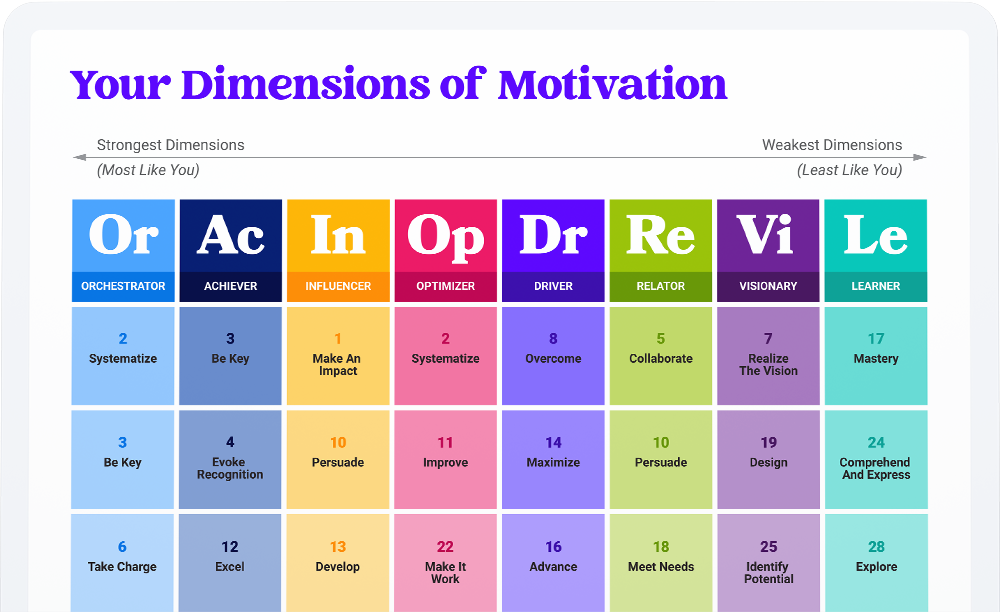
Some of these assessments are great (Working Genius has been a personal favorite), but… you have to force yourself into their pre-defined molds to get their predefined outputs. MCode is different. You tell it YOUR stories and it helps you understand what powered you through those personal wins. It provides structure and actionable intel on your core Motivations to help you think about your work, to create more victories in the future.
Making smarter hiring decisions
Predictive Index (PI) helps organizations predict workplace behavior, match candidates to role requirements, and build teams with compatible behavioral profiles. Motivation Code (MCode) reveals whether candidates will stay engaged doing the actual work required in the role. While PI tells you how someone will behave, MCode tells you why and shows you what will keep them energized month after month.
When you know both behavioral fit and motivational alignment, you hire people who don't just look good on paper and perform well initially — they sustain high performance without burning out.

Building high-performance teams without burnout
The best teams aren't just behaviorally compatible — they are motivationally balanced, understanding what drives each person to show up at their best and contribute their natural strengths and advantages to the team.
Predictive Index excels at revealing team dynamics and potential friction points. MCode explains why friction occurs and how to prevent it. Two team members might have compatible PI profiles but clash motivationally. Or they might have seemingly incompatible behaviors but thrive together because their Motivations align perfectly.

Preventing the quiet quit before it happens
Your biggest retention problem isn't people who leave loudly. It's high performers who disengage slowly. They show up, complete tasks, maintain professional relationships, but stop going the extra mile.
Predictive Index can't predict this dynamic because even when behavioral fit looks fine on paper, an individual can feel drained by their daily work.
If your best people are stuck doing work that fails to tap into their top Motivations, their job satisfaction will plummet. They'll eventually leave or worse, they'll stay but stop caring.

Predictive Index measures behavior, Motivation Code reveals what drives it
Predictive Index assesses four key behavioral drives: Dominance, Extraversion, Patience, and Formality. These drives create a behavioral profile that predicts how someone will naturally approach their work. Results are assigned one of 17 Reference Profiles.
Motivation Code uses personal stories to identify a person's unique ranking of 32 Motivations mapped across 8 Dimensions. Rather than measuring how someone behaves, MCode assesses why they're drawn to certain activities, challenges, or outcomes.
Behavioral fit vs. Performance fuel
The MCode assessment shows you how to structure roles, assign projects, and create conditions that tap into what naturally fuels each person.
Predictive Index: Predictive Index excels at matching behavioral profiles to job requirements. But behavioral fit doesn't guarantee high performance or sustained engagement.
Expected behavior vs. Sustained energy
MCode identifies what sustains performance, regardless of expectations or environment, when behavioral adaptation becomes exhausting.
Predictive Index: PI evaluates how you're expected to act at work and how you naturally see yourself. This reveals the gap between authentic behavior and workplace adaptation.
Action snapshot vs. Motivation blueprint
MCode identifies the motivational patterns that have driven every significant achievement in someone's life — the invisible forces that determine which activities fuel or deplete them.
Predictive Index: The Predictive Index assessment captures behavioral tendencies that predict workplace actions. While useful for understanding general behaviors, they don't explain deeper patterns that shape job satisfaction.
MCode vs Predictive Index Features Comparison
Predictive Index measures behavioral drives that predict workplace actions through a self-assessment questionnaire. Motivation Code uses motivational science to analyze personal achievement stories and reveal the unique motivational themes that drive sustained performance. One shows you how people will likely behave; the other shows you why they'll get started and stay engaged.
How intrinsic motivation fuels energy, drives engagement, and sustains performance.
How behavioral drives and tendencies shape workplace dynamics.
In the 1950s, Art Miller studied the intrinsic motivations of high-performing individuals and created the System for Identifying Motivated Abilities (SIMA). It became Motivation Code with the introduction of modern technology.
Arnold Daniels developed the first PI Behavioral Assessment in 1955. During WWII, Daniels was a navigator who worked with psychologists to study high-performing bombing teams, sparking his interest in psychometrics.
Based on 65 years of motivational science and research analyzing millions of personal achievement stories.
Based on psychometric research: behavioral psychology and factor analysis of workplace behaviors.
Stacked ranking of 32 Motivations mapped across 8 Motivational Dimensions: Achiever, Driver, Influencer, Learner, Optimizer, Orchestrator, Relator, and Visionary.
Scoring of four factors — Dominance, Extraversion, Patience, and Formality — applied to 17 Reference Profiles that each belong to a group: Analytical, Social, Stabilizing, or Persistent.
Individuals share four achievement stories and answer questions about those stories and their satisfaction levels.
Individuals complete a self-reporting questionnaire where they select adjectives that describe them.
Approximately 30 minutes.
Approximately 6 minutes.
What energizes/drains people, why they're drawn to certain work, and what sustains engagement and performance over time.
How people naturally behave in various work environments, and insight into their preferred work style.
How someone is wired for success. Who they are at their best and what they need to do their best work.
How someone will likely act in specific workplace situations based on their unique behavioral drives.
Understanding what energizes/drains you, how to structure work for satisfaction, and why certain roles feel right or wrong.
Understanding personal work style, behavioral preferences, and how you're naturally wired to work.
Building team cohesion, increasing empathy, preventing conflict, and finding alignment.
Analyzing behavioral dynamics and identifying potential friction points between team members.
Identifying job fit, manager fit, and culture fit to learn who will be energized by the job and collaborate well with the manager and the team.
Matching candidate behavioral profiles to job dynamics and role requirements to predict workplace behavioral fit and hiring success.
Understanding what motivates each team member and how to create conditions for sustained high performance.
Identifying the distinct behavioral traits associated with leadership effectiveness and team management style.
Team composition analysis, leadership development, assignment alignment, and management personalization.
Team composition analysis, leadership development programs, and job/role benchmarking.
Making the right hires, understanding team dynamics, performance management, leadership development, retention, and burnout prevention.
Predicting workplace behavior, hiring for behavioral fit, understanding individual and team dynamics, and assessing leadership and management.
Slowing down to learn more about what motivates me has been hugely helpful in every facet of my work and personal life. Discovering my Driver strength and putting a name to my motivation has been great. I'd encourage every team in any industry to get the benefits of MCode.
A Predictive Index alternative?
Predictive Index has earned its reputation as one of the most trusted behavioral assessment tools in business. Companies use PI to make smarter hiring decisions, build stronger teams, and develop more effective leaders. It works because understanding behavioral patterns matters.
Adding Motivation Code takes that behavioral insight and makes it actionable for the long term. MCode reveals why those behaviors exist and what conditions will keep them energized versus drained.
Make hiring decisions that stick
PI helps you identify candidates whose behavioral profile fits the role requirements. MCode shows you whether the actual work will energize or drain them over time. Together, these tools help you hire people who not only can do the job but will stay engaged doing it.
Prevent burnout before it happens
PI tells you how someone will approach their work. MCode reveals what makes that work sustainable. When you know both how someone behaves and what fuels them, you can structure roles that maintain energy instead of depleting it.
Build teams that work well together
PI shows you the behavioral dynamics on your team. MCode explains why certain people clash despite compatible behavioral profiles. When you understand both, you can design team structures that leverage everyone's strengths while minimizing friction.
Develop leaders who inspire high performance
PI identifies behavioral traits associated with effective leadership. MCode shows you how to help leaders create conditions where their teams stay energized. Both tools together equip leaders to adapt their approach based on what actually drives each person.
Retain your best people by designing roles they love
PI helps you understand someone's behavioral preferences. MCode tells you what kinds of challenges, outcomes, and responsibilities will keep them fulfilled. Retention isn't just about behavioral fit — it's about whether someone's core motivations are being met day after day.
Discover your MCode!
See what truly motivates you and experience work at its best.