MCode vs Myers-Briggs Type Indicator
Organizations need more than subjective takes on personality to build high-performance cultures and burnout-resistant workplaces — they need actionable insights that help every member of their teams achieve peak performance and feel fulfilled by their work.
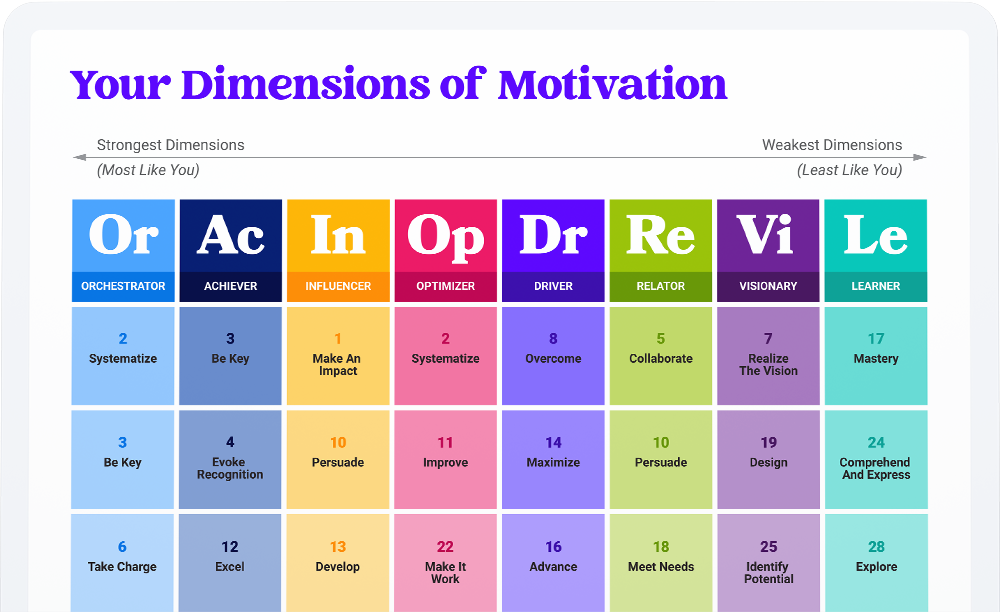
In the past, I've struggled to maintain motivation when projects become routine. Now that I know my MCode, I can proactively take steps to adjust my workflow and project management to ensure my motivation doesn't dip when I need it the most.
The right people in the right roles
The Myers-Briggs Company provides pointed warnings against using the MBTI assessment in hiring, stating it is unethical and it has no predictive value. MCode, on the other hand, provides a direct link to potential engagement and productivity in specific roles.
MCode enhances the hiring process by providing insights into candidates' intrinsic motivations; what lights them up, gives them energy, and drives them to engage, give it their all, and win.
Understanding motivation allows organizations to align candidates' motivations and potential performance with open positions. This ensures job fit goes beyond skills, strengths, and experience.
MCode allows organizations to align a person's work with what they find interesting, meaningful, and rewarding, leading to increased satisfaction and fulfillment.

Personalized professional development
Insights from tools like the Myers-Briggs Type Indicator help leaders understand an individual's preferences, emotional responses, and potential behaviors so they can lead them more effectively. But actually doing that daily is difficult. Luckily, MCode offers a nuanced solution for aligning individual aspirations with organizational goals.
MCode makes it easy for leaders to individualize their leadership and customize professional development opportunities for every employee.
Understanding the unique motivations of each employee helps organizations design development programs, career paths, and opportunities that resonate on a personal level.
MCode maximizes the impact of employee development efforts while demonstrating a commitment to addressing individual needs and aspirations.

Meaningful work environments
MBTI's type-based approach, while useful for understanding personality dynamics, does not directly address the motivational needs that lead to deep job satisfaction and retention. MCode's emphasis on the motivations that drive high performance and deep fulfillment is a powerful asset for developing loyalty and improving employee retention.
When a person's work aligns with their innate strengths and personal motivations, they are more likely to find their jobs and tasks interesting, meaningful, and satisfying.
Leaders who use MCode gain a competitive advantage. They know exactly what each member of their team needs to thrive in their role, become a top performer, and succeed.
MCode empowers organizations to create healthier work environments and high-performance cultures that drive higher job satisfaction, stronger connections, and longer retention rates.

Subjective Preferences vs. Narrative Analysis
The Myers-Briggs Type Indicator is a personality theory that indicates personality types based on subjective preferences that may not always be accurate. The MBTI classifies individuals into 16 distinct personality types based on four dichotomy preferences.
Motivation Code is an objective, practical, proven system that uses scientific narrative analysis to identify motivational patterns of being, strength, personality, engagement, and performance. The MCode assessment maps a personalized ranking of 32 Motivations to a spectrum of 8 Motivational Dimensions.
Personality Dynamics vs. Motivational Alignment
MCode focuses on aligning individuals' roles and actions with their intrinsic motivations to enhance performance, collaboration, and satisfaction.
Myers-Briggs Type Indicator: MBTI focuses on understanding diverse personality dynamics to improve self-awareness, collaboration, and communication.
Fixed Types vs. Fluid Motivations
MCode recognizes the fluidity of motivation. While core motivations remain constant, the specific motivations that individuals tap into may vary based on the role, assignment, or situation.
Myers-Briggs Type Indicator: MBTI assigns individuals to a single personality type regardless of strength of preference score, which leads to inaccurate results.
Personality-Based vs. Motivation-Based
MCode ranks motivation and concentrates on uncovering the 'why' behind an individual's decisions and actions. MCode identifies what propels behavior.
Myers-Briggs Type Indicator: MBTI classifies personality based on preferences in how they perceive the world and make decisions. MBTI does not predict behavior.
MCode vs Myers-Briggs Features Comparison
The MCode assessment and the Myers-Briggs Type Indicator offer distinct methodologies, scientific foundations, and applications in the workplace. MCode focuses on motivational insights derived from a narrative-based, scientifically supported approach. MBTI, rooted in Jungian theory, categorizes personality into types and faces criticism for its binary system and scientific validity.
8 Motivational Dimensions shaped by a ranking of 32 Motivations.
16 distinct personality types based on four dichotomies.
Based on the System for Motivated Abilities (SIMA) created by Art Miller, which studied how personal stories of achievement and fulfillment reveal motivated abilities and how motivation drives fulfillment. Used for decades interview-style by recruiters and executive coaches.
Myers and Briggs based the MBTI on the work of Swiss psychiatrist Carl Jung, research on personality, and their everyday experiences. The indicator was created during World War II, to help women identify the most comfortable and effective war-time jobs.
A narrative-based assessment that combines 60+ years of empirical science, qualitative research, behavioral psychology, and narrative psychology, with decades of research into high performance and the evaluation of millions of stories.
A typology theory that relies on self-reported insights. It was developed by two individuals with no formal training in psychology, psychometrics, or statistics. It was only tested on a small group of local high school students, family, and friends.
Created in the 1950s and originally administered through 1:1 interviews. Technology introduced automation, improved consistency, eliminated potential bias, and introduced scalability. Added focus on high performance strengthened workplace-specific results.
Myers sold the 172-question paper Indicator to a publisher who marketed it to employers. 1987 saw the development of the Form J advanced scoring system with the Form K system developed in 1989. Form J is now known as MBTI Step III and Form K is now referred to as MBTI Step II.
Individuals share personal stories of achievement and fulfillment and answer questions about their lived experiences to discover their ranking of 32 Motivations and Motivational Dimensions.
Individuals complete a questionnaire that assesses their preferences in how they view the world and make decisions to indicate a four-letter code that represents one of 16 personality types.
The Motivation Code assessment experience and report are always the same and only available through Motivations AI. It is objective, unbiased, and reliable.
Myers & Briggs Foundation holds the copyright and trademarks for the Myers-Briggs Type Indicator. The Myers-Briggs Company offers the official assessment.
Applicable in personal growth, career planning, coaching, team dynamics, performance, hiring, talent development, leadership development, and organizational development.
Applicable in personal development, career planning, team building, workplace dynamics, interpersonal relationships, conflict resolution, coaching, and communication skills.
Ability-focused and centered around individuals' natural advantages and innate drivers. Provides an understanding of how individuals are motivated to engage, persist, and do their best, and why they behave the way they do at work and in life.
Personality-focused and centered around how individuals perceive the world and how personality influences behavior. Provides self-awareness and insights to improve interpersonal understanding and workplace satisfaction.
Individuals may feel pressure to pick the "right stories" or the stories they believe will paint them in the best light. Some find it difficult to decide which stories to share as part of the assessment process.
Self-reporting assumes people already have self-awareness and risks inaccurate results due to individuals answering questions based on aspiration or what they believe to be expected or desired.
Slowing down to learn more about what motivates me has been hugely helpful in every facet of my work and personal life. Discovering my Driver strength and putting a name to my motivation has been great. I'd encourage every team in any industry to get the benefits of MCode.
A Myers-Briggs alternative?
MBTI is arguably the most popular workplace assessment, yet it was never intended to be used as an exclusive method for career planning. Its creators specifically stated personality type does not identify job fit or predict behavior and that the MBTI should not be used in the hiring process. The good news is that the Motivation Code assessment fills critical MBTI gaps.
By integrating MBTI's insights into personality dynamics with MCode's deep dive into individual motivations, organizations can create a more nuanced and holistic approach to talent management.
Self-awareness and personal growth
MBTI and MCode support workplace cultures that value self-awareness. MBTI promotes the appreciation of diverse personalities while MCode deepens this understanding by revealing the 'why' behind people's actions.
Recruitment and Role Alignment
MBTI provides a preliminary understanding of how a candidate might fit into a team or organizational culture. MCode offers additional depth by ensuring that a candidate's core motivations align with the role and organization's values.
Meaningful Employee Development
MBTI identifies employees' natural strengths based on preferences and personality types. MCode builds on this by identifying motivational drivers, enabling personalized development plans that play to strengths and ignite intrinsic motivation.
Enhanced Team Dynamics
With insights from both tools, teams better understand and respect each other's differing approaches to work, collaboration, and communication. This shared awareness can strengthen connections, improve empathy, and reduce conflict.
Better Leadership Development
When leaders have access to MBTI and MCode results, they become more effective and inspiring leaders. They are empowered to personalize their leadership approach to fit each individual member of their team.
Discover your MCode!
See what truly motivates you and experience work at its best.